Furniture Outlet Buying Guide
Platform Bed Frames at Outlet Stores: How to Assess Support and Construction
A low price can make a platform bed frame feel like an easy win. But the details that matter most are often out of sight: the spacing between its slats, the strength of its center support, and the way its joints hold together. Here’s how to look past the clearance tag and decide whether a frame is right for your mattress, your room, and the years of everyday use ahead.
Published October 14, 2026
Outlet shopping can be a treasure hunt. One visit might turn up a floor model with a small scuff, a discontinued finish, or a piece that has simply been waiting for a new home. Another might offer a frame that looks polished from the aisle but leaves important questions unanswered. With platform bed frames, appearance and price tell only part of the story. The support system is what carries the mattress and sleepers, night after night.
That is why a furniture outlet store visit calls for a little detective work. Check the slats, center rail, legs, joints, and hardware. Then compare what you see with the mattress maker’s support requirements and the frame manufacturer’s stated limits. A marked-down price is worth considering only after you know what is included, what condition the frame is in, and what happens if it does not work out.
This guide explains how to assess platform bed frame construction in person, what to ask about outlet inventory, and how to make a thoughtful decision without mistaking a bargain label for a quality guarantee.
First, understand what a platform bed frame does
A platform bed frame is designed to support a mattress on a built-in surface, commonly a series of slats or a solid platform. Unlike some traditional bed setups, it may not require a separate box spring. That does not mean every platform frame works with every mattress, though. Mattress construction, manufacturer guidance, and the frame’s own design all matter.
Some frames use widely spaced wooden slats; others have closely spaced slats, a metal grid, or a nearly solid deck. A center rail may run lengthwise beneath the platform, and extra legs may connect that rail to the floor. Each element has a job. Slats distribute the mattress load, rails help keep the frame square and steady, and legs transfer weight to the floor.
When you are browsing outlet furniture, start by identifying the actual support design rather than relying on a label such as “platform,” “modern,” or “heavy duty.” Ask to see the frame’s underside if possible. If it is assembled, inspect it from the sides and underneath; if it is boxed, request the assembly details and specifications before committing.
The slat check: spacing, condition, and consistency
Slats are among the most important details to inspect. Look along the full length of the sleeping surface. Are the slats straight and evenly spaced? Do they sit securely in their supports? Are any cracked, bowed, loose, or missing? A single damaged piece can affect the way weight is distributed, while an uneven arrangement may create unsupported areas beneath the mattress.
There is no universal slat-spacing rule that applies to every mattress. The appropriate spacing depends on the mattress maker’s instructions and the support system the frame is designed to provide. Memory foam and other mattresses may have specific foundation requirements; some warranties also specify a maximum gap between slats. Check the warranty and care documentation for the mattress you own or plan to buy, and ask the outlet for the bed frame’s documented specifications.
Do not guess based on a quick glance. If spacing is not listed, measure the gap between slats and record it. Then compare that measurement with the mattress maker’s requirements. If the store cannot verify the frame’s dimensions or intended compatibility, treat that as an unresolved question—not proof that the frame will be unsuitable, but a reason to pause before purchasing.
Look at how the slats are retained. Some rest in molded holders or notches; others are attached with screws, straps, or a connected webbing system. Check that the supports are present and that slats do not slide out with light pressure. On a floor model, be alert for evidence of repeated movement: loosened fasteners, worn slots, or marks where a slat may have shifted.
Wood type alone does not settle the question of performance. Slat thickness, width, span, spacing, and how the slats are fixed all contribute to the finished support system. A frame made with a sturdy-looking material can still have a weak arrangement, while a simpler design may perform well when properly constructed and used within its stated limits.
Follow the center rail all the way to the floor
A center rail is a structural backbone for many larger platform frames. It helps support the middle of the bed and can reduce the unsupported span across the frame. Inspect it from end to end. It should be firmly connected, not visibly twisted, bent, or separated from its fittings. If the frame includes center legs, check that they are present, secure, and positioned to make solid contact with the floor.
Do not assume every platform bed needs the same number of center supports. The design, size, materials, and manufacturer’s specifications determine what is appropriate. Instead, confirm what the particular frame is designed to provide. Ask the retailer for the maker’s guidance on mattress size, maximum supported load, and recommended use. If the frame is missing a listed center rail or a support leg, find out whether the part can be replaced and whether the frame can be safely assembled without it. Do not rely on a verbal “it should be fine” where a missing structural component is concerned.
Take a moment to check the outer rails and corner connections, too. A bed that rocks, creaks, or shifts when gently pressed may have loose joints, damaged hardware, or an uneven floor beneath it. A store display can be imperfectly assembled, so a wobble does not automatically mean the product is defective—but it should prompt a closer inspection and a clear answer about how the bed will be supplied.
Legs, joints, and the small signs of solid construction
Legs should sit flat and feel secure at their attachment points. Look for cracks near screw holes, crushed corners, missing glides, or repairs that have not been described. On a frame with a center support, make sure the center legs are not shorter in a way that leaves them suspended above the floor once the frame is assembled. Uneven flooring can also affect stability, so consider where the bed will sit at home.
Examine the joints where rails meet the headboard, footboard, and side supports. The connections should look intentional and complete, with hardware seated properly and no obvious splitting or gaps. Ask whether the fittings are original to the frame. A handful of spare bolts in a bag does not necessarily mean a kit is complete: assembly instructions should identify the hardware needed and where it goes.
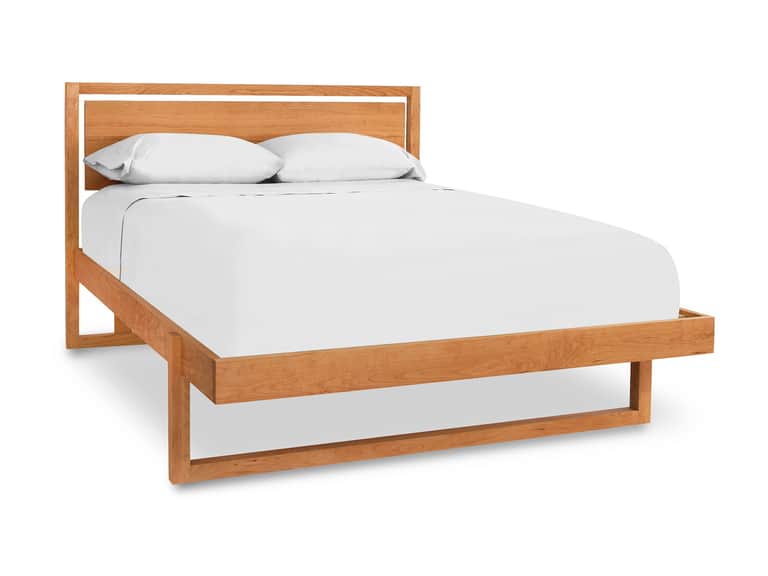
Construction details can be easier to understand through real examples. The Pendant Bed, for instance, is described as using solid sustainably harvested cherry wood and traditional joinery. The Cherry Moon Bed is described as a solid-wood design with shaped details and a handmade, built-to-order construction. These descriptions are useful examples of the kind of material and construction language shoppers may encounter. They do not, by themselves, establish compatibility with a particular mattress or indicate outlet availability. For any frame, verify its own support specifications and condition.
Finish deserves attention as well, especially on a floor model or clearance piece. Small surface scratches may be cosmetic, but deep gouges, swollen areas, peeling finish, or evidence of water exposure deserve careful questions. Look at edges and undersides as well as the most visible surfaces. A neat finish cannot prove that the frame is structurally sound, but damage can reveal how the piece was handled or stored.
Decode the outlet label before you decide
“Outlet,” “clearance,” and “floor model” can describe different circumstances. A frame may be discontinued, overstocked, returned, displayed in a showroom, or sold with a cosmetic imperfection. Those labels do not automatically tell you why the item is discounted, whether it is complete, or whether the same terms as a regular-stock purchase apply.
Ask what specifically explains the price. If the answer is a scratch, ask where it is and whether it is noted on the receipt. If the frame is a floor model, ask how long it has been assembled and whether it has been moved or repaired. If it is boxed, confirm whether the box is sealed, whether all parts are believed to be present, and who handles a missing-part issue. Get material answers in writing when practical.
Find out whether the outlet item is sold as new, open-box, returned, or as-is. These categories can affect your options if you discover damage or missing parts after delivery. Store policies vary, so read the actual terms rather than assuming that outlet furniture follows the same return process as regular merchandise.
Ask about the manufacturer’s warranty and the store’s separate return or exchange policy. Is the warranty valid for this item? Does it cover the frame’s structural components, and are there exclusions for floor models, clearance, or as-is purchases? What is the time window for reporting a defect? A warranty and a return policy are not the same thing: one may address covered product issues, while the other determines whether the retailer will accept a return or exchange.
Fit the frame to the mattress—and the room
Before leaving home, note your mattress size and consult its manufacturer’s support requirements. At the store, confirm the frame is intended for that size, not merely a similar-sounding one. Ask for the assembled outside dimensions as well as the mattress platform dimensions. Headboards, footboards, and projecting legs can make a frame larger than its sleeping surface suggests.
Measure the bedroom, too. Account for doorways, stair turns, elevators, and the route from the entrance to the room. A frame that fits once assembled may be difficult to carry through a narrow passage. If it comes in multiple pieces, check the dimensions of the largest boxed component and ask whether assembly or delivery is available and what those services include.
Think about clearance around the bed. Will drawers, closet doors, or bedroom doors open fully? Is there enough room to walk on both sides? A low-profile platform frame can make a small room feel more open, but it may also change how much under-bed storage is possible. If you plan to store items beneath it, measure the clearance rather than estimating from the showroom floor.
Finally, consider the surface where the frame will stand. Uneven floors can exaggerate movement and strain connections. Felt pads or adjustable glides may help with minor floor variation, but they are not a substitute for correct assembly or a stable support design. Ask whether the frame includes floor protectors and whether any additional support components are required.
A practical in-store inspection, step by step
It is easy to overlook details when a showroom is busy or a clearance item seems likely to sell quickly. A simple routine keeps the decision grounded. Start with the frame’s identity: note the model name, size, material, and whether the item is new, returned, or a display piece. Then check its support structure before spending time weighing the finish or styling.
- Inspect the platform. Count the slats if useful, look for gaps or damage, and confirm they are held securely.
- Check the center support. Locate the center rail and legs, then look for missing, bent, loose, or visibly altered parts.
- Look over the frame’s connections. Check corners, brackets, bolts, and joinery for looseness, cracking, or gaps.
- Assess condition honestly. Note scratches, dents, finish wear, and signs of repair; ask which marks will be recorded on the sale paperwork.
- Verify compatibility. Match the bed’s size and support specifications to your mattress maker’s requirements.
- Confirm what comes with it. Ask about hardware, assembly instructions, support components, delivery, and replacement parts.
- Read the terms. Check return, exchange, warranty, and as-is conditions before paying.
If the frame is already assembled, do not climb on it or subject it to a hard stress test in the store. A gentle push can reveal obvious rocking, but it cannot certify load capacity or long-term performance. The manufacturer’s specifications and complete assembly instructions are more reliable sources for those answers.
Questions worth asking the store
A good question is specific enough to get a useful answer. Instead of asking whether a frame is “sturdy,” ask what the manufacturer says about its support system and which components are included. If a salesperson does not have that information, ask whether they can locate the product documentation or contact the supplier. You can always take time to confirm details before making a decision.
- What is the exact model and mattress size?
- What are the slat dimensions and spacing?
- Does the frame include a center rail and center support legs?
- What mattress types and sizes does the manufacturer specify as compatible?
- What is the stated weight capacity, and how is that figure defined?
- Is the frame complete, and are its assembly instructions and original hardware included?
- Why is this particular item discounted?
- Are the visible marks, repairs, or missing parts recorded on the receipt?
- What return, exchange, and warranty terms apply to this item?
Weight-capacity figures deserve special care. Retail descriptions do not always explain whether a rating refers to the mattress and sleepers together or to another measure. Ask how the figure is defined and follow the manufacturer’s guidance. Do not calculate a safe limit from appearance, timber thickness, or the number of legs alone.
When a lower price is—and isn’t—a better value
A discount is useful only if the frame meets your needs and the risks are clear. A modest cosmetic mark on a complete, compatible frame may be an acceptable trade-off for some buyers. A missing center rail, unknown slat spacing, or unclear return terms can be a very different proposition. Compare the full cost, including delivery, assembly, replacement parts, and any support items the mattress maker requires.
It also helps to compare like with like. A higher-priced frame may include hardware, a headboard, or delivery that an outlet item does not. Conversely, an outlet frame might be a good fit if its specifications are documented and its condition and terms are transparent. The goal is not to decide that outlet furniture is always a bargain or always a compromise. It is to understand what you are buying.
Take photos of the item and any disclosed marks, if the store permits it. Keep a copy of the receipt, product specifications, and written policy. If the bed is delivered, inspect the shipment before assembly and report any issues within the time stated by the retailer. Following the instructions matters: incorrect assembly can create instability and may affect warranty coverage.
Common myths about outlet platform beds
“A heavy frame must be a strong frame.”
Weight alone is not a reliable measure of construction quality. Materials, connection design, support placement, and assembly all contribute. A frame can feel substantial but still have inadequate support for a particular mattress.
“If it does not wobble in the showroom, it is compatible.”
A brief stability check cannot establish that slat spacing or other details meet a mattress maker’s requirements. Confirm compatibility using the relevant specifications.
“Outlet means factory seconds.”
Outlet inventory can come from several sources, including discontinued merchandise and display models. Ask about the specific item instead of assuming why it is discounted.
“A platform frame never needs extra support.”
Support needs vary by frame and mattress. Follow the frame’s assembly guidance and the mattress manufacturer’s requirements; do not add or remove parts based on a general rule.
A quick checklist before you buy
- I know the exact model, size, and condition of the frame.
- The slats are complete, secure, and consistent, and their spacing is documented or measured.
- The center rail and all listed support legs are present and appear intact.
- The frame’s specifications match the mattress maker’s support requirements.
- I have checked joints, hardware, finish, and any visible wear.
- The store has explained what is included and why the item is discounted.
- I understand the return, exchange, warranty, and as-is terms.
- I have measured the room, access route, and space around the bed.
The bottom line
The best platform bed frame is not necessarily the one with the most elaborate finish or the biggest markdown. It is the one whose support system is complete, whose construction is in good condition, and whose specifications suit your mattress and household. At an outlet, that means slowing down enough to inspect the slats, center rail, legs, joints, and hardware—and to ask direct questions about the item’s history and terms.
Look for documented details, not promises based on appearance. A clear answer about mattress compatibility, a complete parts list, and written return conditions can make a discounted purchase easier to evaluate. If important information remains uncertain, taking a little more time is part of smart outlet shopping. Your bed frame has a quiet but essential job; it is worth choosing with care.
Frequently asked questions
How do I know whether a platform bed frame will support my mattress?
Check the mattress maker’s foundation requirements and compare them with the frame’s specifications, including slat spacing and the intended mattress size. If either set of guidance is unclear, contact the manufacturer or retailer for confirmation rather than assuming that all platform frames are compatible.
Should I avoid a floor-model bed frame?
Not automatically. A floor model may have cosmetic wear or loosened hardware from display use, so inspect it closely and ask about its condition. Confirm that all components are included and understand whether the store’s return and warranty terms differ for display items.
Is a center rail essential on every platform bed?
Support systems vary by frame size and design. Follow the manufacturer’s assembly instructions and specifications for the particular model. If the frame is supposed to include a center rail or legs, do not treat missing parts as optional without written confirmation from the manufacturer.
What should I do if an outlet frame is missing hardware?
Ask the store to identify the missing parts and confirm whether original replacements are available before purchase. Do not substitute unrelated hardware or assemble the frame with an incomplete kit unless the manufacturer provides appropriate instructions.